

Building a race simulation workout for HYROX takes about 90 minutes of focused effort to design and execute. This guide walks you through the exact steps to create a session that mimics the demands of the actual race. You will learn how to balance running and lifting to test your pacing and endurance. By the end, you will have a structured plan that prepares your body for competition day.
Before You Start
You need a few prerequisites before building your simulation. First, ensure you have access to a gym with the necessary equipment. You will need a rowing machine, ski erg, sled, and standard lifting platforms. Second, you must understand the basic format of a HYROX race. HYROX is a fitness race that combines running and functional lifting stations. Third, you should have a baseline fitness level that allows you to complete a 1km run without stopping. If you are new to training, consider starting with a Group Training session to build your base.
Step 1: Define Your Race Distance
The first action is to set the total running distance. A standard HYROX race consists of eight 1km runs. This totals 8km of running. You must decide if you are simulating the full race or a partial version. For a full simulation, you will run 1km between every station. This creates a total of 8km of running. The result should be a clear understanding of the volume you are about to perform. Do not skip this step, as it dictates the intensity of the entire session.
Step 2: Select the Eight Stations
Next, you must choose the eight functional lifting stations. The official HYROX race includes specific stations such as the SkiErg, Sled Push, Sled Pull, Burpee Broad Jumps, Rowing, Farmers Carry, Sandbag Lunges, and Wall Balls. You should select these exact movements to ensure accuracy. A race simulation is a training session that replicates the specific movements and order of a competition. If you are training at HYROX Training classes at Colfax Strong, the coaches will guide you through these specific stations. For your own workout, list these eight movements in the order they appear in the race.
Step 3: Assign Running Segments
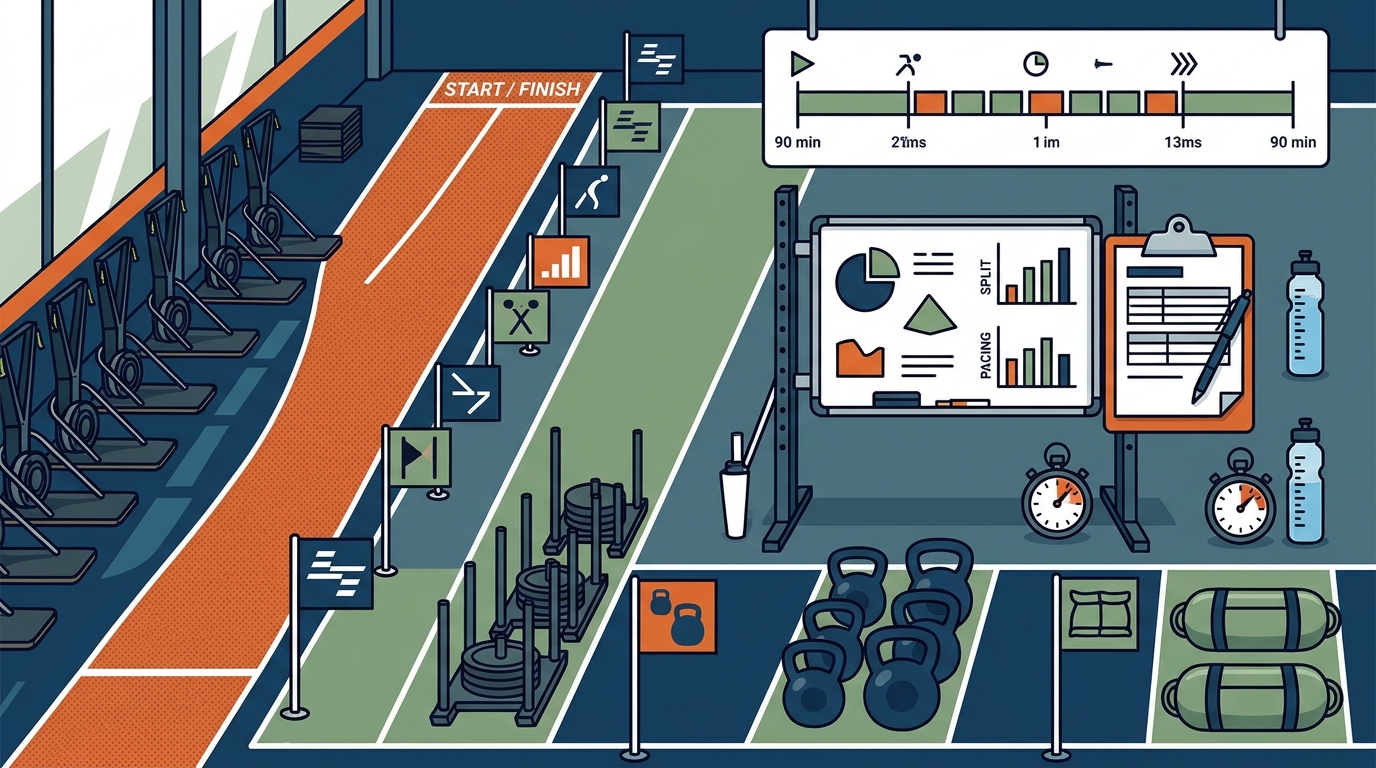
Now, assign the running segments between the stations. You will run 1km before the first station. Then, you run 1km between each subsequent station. This means you run after the last station as well. The total running distance remains 8km. The result is a clear map of where the running occurs. This structure forces you to manage your heart rate between lifts. It is crucial for building the aerobic engine needed for race day.
Step 4: Set Rep Counts and Weights
The fourth step is to determine the rep counts and weights for each station. You must use the official HYROX standards for your division. For example, the Wall Ball station requires 100 reps. The Sled Push requires 50 meters. You should look up the specific weight requirements for your category. Men and women have different weight standards. The result is a set of specific numbers for each movement. Do not guess these numbers. Use the official HYROX guidelines to ensure your simulation is accurate. This step is critical for testing your true race readiness.
Step 5: Sequence the Workout
Sequence the workout by combining the runs and stations. The order is: Run 1km, Station 1, Run 1km, Station 2, and so on. You must follow the exact order of the race. This ensures you are testing your ability to transition between movements. The result is a complete workout plan on paper or in an app. You should write this down before you start. Having a clear sequence reduces decision fatigue during the workout. It allows you to focus on execution rather than planning.
Step 6: Execute and Track Data
Execute the workout and track your data. Use a watch or app to record your time for each segment. Note your heart rate and perceived exertion. The result is a set of data points that show your pacing. Analyze this data after the workout. Look for where you slowed down. This helps you identify weaknesses in your training. If you are training with a coach, they can review this data with you. Personal Training can help you interpret these results and adjust your plan. Tracking data is essential for continuous improvement.
When It Goes Wrong
Problem 1: Going Too Fast Early
Many athletes start the first stations too fast. This leads to burnout by the end. The fix is to practice pacing. Aim for a steady effort in the first half. Save your energy for the final stations. This ensures you finish strong.
Problem 2: Equipment Availability
You may not have access to all HYROX equipment. The fix is to substitute movements carefully. Use a rowing machine for the SkiErg if needed. Ensure the substitute movement targets the same muscle groups. This keeps the simulation relevant.
Problem 3: Transition Delays
Slow transitions between stations can cost you time. The fix is to practice quick transitions. Set up your equipment in advance. Know exactly where to place your weights. This reduces wasted time and improves your overall score.
Frequently Asked Questions
How often should I do a race simulation?
You should perform a full race simulation once every two to four weeks. This frequency allows you to test your progress without overtraining. It gives you enough time to recover and improve between sessions.
Can I do a race simulation at home?
Yes, but you need the right equipment. You will need a rowing machine, sled, and space for burpees. If you lack equipment, consider training at a facility like Colfax Strong where all HYROX gear is available.
What is the best way to track my progress?
Use a fitness watch to track time and heart rate. Record your total time and segment times. Compare these numbers across multiple simulations. This shows you where you are improving and where you need work.
Do I need to follow the official HYROX rules?
Yes, for an accurate simulation. Follow the official rep counts and weights. This ensures your results are comparable to actual race performance. Deviating from the rules makes the simulation less useful.
Where can I find HYROX training in Denver?
Colfax Strong offers structured HYROX training classes. You can check their schedule for available times. This is a great way to train with coaches who understand the race format.
Conclusion
Structuring your own HYROX race simulation is a powerful way to test your readiness. By following these steps, you create a session that mirrors the actual race. You will gain valuable data on your pacing and endurance. If you want to train with expert guidance, Colfax Strong offers official HYROX training. Their classes are designed to help you perform your best on race day. To get started, Claim Your Free Intro at Colfax Strong Strength & Conditioning in Denver, CO.